~ # ~
BIBLE MYSTERIES -
The Mystery of GOG
~ # ~
Much has been written in speculation about the names Gog and
Magog. Unhappily, recently
a good deal of it has been misleading.
Indeed, perhaps the greatest mystery of Gog and Magog is how Revelation
Chapter 20 got downgraded to 'incidental' - at best - or 'apostate' at
worst.
Rev 20 starts: [1] And I saw an
angel come down from heaven, having the key of the bottomless pit and a
great chain in his hand. [2] And he laid hold on the dragon, that
old serpent, which is the Devil, and Satan, and bound him a thousand years,
[3] And cast him into the
bottomless pit, and shut him up, and set a seal upon him, that he
should deceive the nations no more, till the thousand years should be
fulfilled: and after that he must be loosed a little season.
Verse 7 continues: And when the
thousand years are expired, Satan shall be loosed out of his prison,
[8] And shall go out to deceive
the nations which are in the four
quarters of the earth, Gog
and Magog, to gather
them together to battle: the number of whom is as the sand of the sea.
[9] And they went up on the
breadth of the earth, and compassed the camp of the saints about, and
the beloved city: and fire came down from God out of heaven, and
devoured them. [10] And
the devil that deceived them was cast into the lake of fire and
brimstone, where the beast and the false prophet are, and shall be
tormented day and night for ever and ever.
Certain facts stand out in these passages, and do not seem at all
ambiguous; 1/ Satan will
be bound for one thousand years; 2/
after the thousand
years Satan must be loosed 'a
little season' [see Calendar
and Numbers];
3/ During this little season will occur Gog and Magog.
For some inexplicable reason there is a teaching prevalent in the
Church today that Gog and Magog will occur before the thousand years,
and that the battle that ends this present age [generally considered to
be Armageddon] is the
end of all things. After the thousand years - they say - comes the New Jerusalem and ... [?] Har
Mageddon - the Valley of Megiddo, the Valley of Jezreel - is not the 'beloved city of
the saints'.
These Scriptural passages have been written right out of the Bible.
Prominent televison teachers and preachers have subscribed to this
fantasy, and more and more appear to come aboard with each passing
year. It is not this author's intent to sew contention or confusion
amongst the faith; rather, he wishes to plead the inerrancy of
Scripture and call the faithful back to Scriptural tenets.
Perhaps the answer lies in the fact that Ezekiel starts both Chapter 38
and Chapter 39 the same way, implying that there could be two invasions
by a Gog-like force, one before the Millennium of Peace and one
following; this author is doubtful of this interpretation, however.
======================================
One of the keys to the mystery of Gog and Magog may be four quarters
in the Scripture quoted above. We will return to this theme momentarily.
Magog first appears in
the Bible in Gen 10:2 as one of the seven sons of Japheth. He appears
to be paired with Gomer, the first son of Japheth. The name Gomer means
'completion', but comes from a root meaning 'to end in failure'. Magog
is taken to be the name of a place [as per Ezekiel] and an expansion of
the name Gog ['Land of Gog']; the Hebrew word for Gog -  - is considered
to be of uncertain
derivation. This seems unsatisfactory in the case of the name of
Japheth's second son. Speculation is likely futile in the face of such
lack of etymological evidence, but a homonym of magog can be found in Hebrew as miqqâch 'taking' [II
Chron 19:7] and maqqâchâh
'something received, merchandise' [Neh 10:32]. These derive from a root
lâqach 'to take,
fetch,
seize'.
- is considered
to be of uncertain
derivation. This seems unsatisfactory in the case of the name of
Japheth's second son. Speculation is likely futile in the face of such
lack of etymological evidence, but a homonym of magog can be found in Hebrew as miqqâch 'taking' [II
Chron 19:7] and maqqâchâh
'something received, merchandise' [Neh 10:32]. These derive from a root
lâqach 'to take,
fetch,
seize'.
Perhaps a better homonym is mechûgâh
'a compass', from chûg
'to compass, a
circle' [see 'compass',
Rev 20:9 (above)]. chûg
is a fitting
homonym of Gog.
 As
the pre-Millennial Battle of Armageddon is about the descendants of HAM,
the post-Millennial war of Gog is about Japheth and his offspring.
Genesis 10:2 lists the sons of Japheth as Gomer [from whom
(traditionally): the Cimmerians and Cimbri], Magog [from whom: Scythians],
Madai [from whom:
Medes], Javan [from
whom: Greece, Syria], Tubal
[perhaps preserved in the city's name: Tobolsk; one branch also
believed to have settled Spain], Meshech [taken to be the same
as modern Moscow] and Tiras [from whom: the
Thracians]. Generally these amount to Europe and the Russias - the
'northern' people.
As
the pre-Millennial Battle of Armageddon is about the descendants of HAM,
the post-Millennial war of Gog is about Japheth and his offspring.
Genesis 10:2 lists the sons of Japheth as Gomer [from whom
(traditionally): the Cimmerians and Cimbri], Magog [from whom: Scythians],
Madai [from whom:
Medes], Javan [from
whom: Greece, Syria], Tubal
[perhaps preserved in the city's name: Tobolsk; one branch also
believed to have settled Spain], Meshech [taken to be the same
as modern Moscow] and Tiras [from whom: the
Thracians]. Generally these amount to Europe and the Russias - the
'northern' people.
Ham's descendants peopled Canaan, Egypt, Libya and Africa; Shem peopled
Mesopotamia, Assyria and - through Abraham - Canaan [Palestine]. The
Philistines could descend from the Greeks, and some think the same of
Phoenicians, who also settled Carthage.
Having established the general European theater, especially northern
Europe, as the source of Gog, it may be that the meaning of the name
could be found in one of those tongues.
Ezekiel adds a great bit of intelligence to our understanding of Gog
and Magog. First both Chapter 38 and 39 begin with ...Gog ... the chief prince of Meshech
and Tubal... The Hebrew word for 'chief' is rôsh [RASh]; it is
quite proper to interpret such a prophetic clue as rôsh = Russia [although it should be
kept in mind that it is also possible that such a prophetic clue is a
'blind'.] For example, 38:4 says: I
... will put hooks into thy jaws... The word for 'hooks' is châch[-im (plur.)], a homonym of Gog. The word for 'search' in
Ezk 39:14 is châqar
'to penetrate', which also contains a homonym of Gog.
Ezk 38:7 states: ...be thou a
guard... The Hebrew for 'guard' is mishmâr 'a watch, a
prison'; it derives from a root shâmar
'to hedge about, look narrowly', also 'watchman'. As suggested, we can
look at the European languages, where we find a Germanic cognate gucken 'to look, peer'. This
relates to Gaelic gocaman
'sentinel', thought to derive from Scandanavian gok-man 'look-out man'. This
probably also appears in Scottish gowk,
which leads to Norse gaukr
'cuckoo, silly person'
[perhaps a fitting description of Gog.] We likely find a relative of
this linguistic thread in the Old Provençal gach 'a sentinel, jay' [as one who
cries out in warning.]
In regard to Rev Chapter 20, Ezk 38:8 says ...in the latter years thou shalt
come... The Hebrew word for 'latter' is acharîth 'last, end',
from a base achar 'the
hind part, following'; 'years' is shâneh which can also
mean 'age', and comes from a root shânâh 'do a
second time'. This would seem to lend weight to a post-Millennial
dating.
Verse 6 of Chapter 38 says: Togarmah
of the north quarters
[tsâphôn
'dark, north (quarter)', yerêkâh
'recess, side, part']. This reflects the passage of Rev 20:8 (above),
which uses the Greek term four quarters
[tessares gōnia]. The
term four (quarters) becomes
quite interesting if translated into Hebrew. The Hebrew word for four is arbâ'h [ARBA'H]; arbeh [ARBH] is 'locust' [as multitudinous] from a root râbâh 'to
increase'; orobâh
[ARBH] means 'spoils, ambuscades', from a root ârab 'ambush, lie in
wait, lurk'; arubbâh
[ARBBH] means 'window, chimney, lattice' [Is 24:18].
One might be naturally lead to ask why none of these words appear in
Ezekiel 38-39 [see next paragraph]. This author believes the reason is
that these terms relate to Arâb
[as rôsh
could hint at Russia],
which also means 'ambush'; clearly Ezekiel intended the sons of Japeth
from the 'north quarter' to be the subject of these chapters.
Japheth means 'expansion', from a root meaning 'to enlarge'
['increase']. Rev Chapter 9 mentions locusts
and 200 million 'horsemen' ['multitudes']. Ezk 38:12-13 each mention a spoil; the Hebrew is shâlâl; Ezk 39:10
uses the verbal root shâlal.
Ezk 38:12-13 also mention take a
prey...; the word for 'prey' is baz. The word for 'shaking'
in Ezk 38:19 is ra'ash
- another hint at Russia
- from a root which means 'to undulate, spring as a locust'.
The word for 'passenger' in Ezk 39:11, 14-5 is 'âbar - a slight
variation of which is also used for 'quarter' - and indicates the
source of the word Hebrew
['cross over'], apparently because Abraham crossed over Jordan [or the Arabian
Desert] to settle in the land of Canaan.
Of passing interest, Ezk 39:18 states: Ye shall eat the flesh ... and drink
the blood of the princes of the earth ... bullocks ... fatlings of
Bashan; the word for bullocks
is pâr,
and Bâshân
is often related to a word for 'shame', although it is usually
considered to be of foreign derivation. At the time of Moses Bashan was
ruled by a king named Og.
The word for filled in
39:20 is sâbêa',
which could hint at Sheba
[38:13] or Sabean, taken to
mean 'travelling merchants'.
 To the right is a drawing of the 'angel of the bottomless
pit' [Rev. 9:11] by Francis Barrett; his authority for this
characterization is unknown. The Greek apollyon means 'a destroyer',
from apollumi 'to
destroy fully'. The verse tells us the Hebrew name of this spirit is Abaddon, which means 'a
perishing' from âbad
'to wander away' [Jn 6:66] 'to destroy, perish'.
To the right is a drawing of the 'angel of the bottomless
pit' [Rev. 9:11] by Francis Barrett; his authority for this
characterization is unknown. The Greek apollyon means 'a destroyer',
from apollumi 'to
destroy fully'. The verse tells us the Hebrew name of this spirit is Abaddon, which means 'a
perishing' from âbad
'to wander away' [Jn 6:66] 'to destroy, perish'.
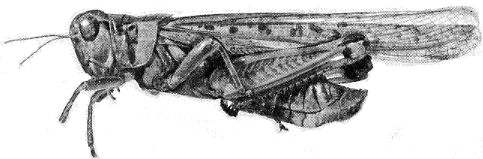 The Greek word for locust is akris; akrisía means 'confusion, lack of
judgment'; akros, akron means 'end, extreme,
peak'; the two are related through the idea that the locust alights on the tip of vegetation. Similarly, the
locusts appear at the extreme
end of Biblical time - the latter
days. If we accept this premise, the implication is that some of
the events of the Book of Revelation relate to the post-Millennial period.
The Greek word for locust is akris; akrisía means 'confusion, lack of
judgment'; akros, akron means 'end, extreme,
peak'; the two are related through the idea that the locust alights on the tip of vegetation. Similarly, the
locusts appear at the extreme
end of Biblical time - the latter
days. If we accept this premise, the implication is that some of
the events of the Book of Revelation relate to the post-Millennial period.
The best way to understand Biblical symbols is to study their natural
characteristics. Locusts
are nowhere to be seen for a long season, hidden underground; suddenly
they appear
seemingly out of nowhere in huge swarms, enough to 'cloud' and darken
the skies.
Nothing can deter their destructive drive; they consume everything
edible in their path. When they have completely destroyed vegetation in
an area they move on. When their orgy of chaos is finished they
disappear and are not seen again or remembered for a long
season. During their feeding season they have no 'king'. They follow
their destiny with a great noise, and under some circumstances they are
fit for food for humans [Lev 11:22]. Their abbreviated end is brought
about when the LORD
blows them into the sea with a strong wind [Ex 10:19]. In the Holy Land
the source of locusts was generally thought to be Persia or Arabia.
Ezk 38:22 states that the LORD will contend with Gog with fire [êsh] and brimstone [gophrîth < gôpher]; in Rev 9:17
fire and brimstone issue from the mouths of myriads of horses. Ezekiel
30:3 says: the day of the
LORD is near, a cloudy day... Joel
2:1-2 says ...the day of the LORD ... a day of darkness and gloominess,
a day of clouds and thick darkness... The
word for cloudy is 'ânân
'a cloud, covering' from a root that means 'to practice magic or
sorcery'. Ezekeil 38:9 & 16 say that Gog shall be as a cloud. In the Book of
Revelation, however, clouds seem to be associated with heaven.
~

