The Mystery of
C A I N and A B E L
 Peter Paul Rubens [1609] Cain Slaying Abel
The story of the first brothers - Cain and Abel - takes up only a small
portion of Scripture: Genesis chapter 4. While the events are dramatic,
the exposition is minimal. It has been pointed out that, if G*d had not
accepted Abel's offering and Jesus had not proclaimed him 'righteous'
in Matthew 23, the whole incident might have passed with little notice.
Much has been written about why Cain's sacrificial offering was not accepted,
and why he came to be filled with anger over the distinction between
his offering and his brother's. Yet, despite much good thought and
effort, little has really proved decisive in settling the mystery.
The story is familiar to the followers of three of the world's major
religions; Cain is crestfallen over G*d's acceptance of Abel's
sacrifice from 'the firstlings' of his flocks while G*d had 'not
respect' towards Cain's offering of his 'fruit of the ground'. In anger
Cain rises against his brother Abel and slays him in the fields.
We are not told whether Cain returns Abel's body to the ground, but
since the Voice of G*d asks Cain where his brother might be found it
could be presumed that the body is buried [whether Cain understood that
flesh was created from the ground or in order to hide his guilt is not discernable.]
 William
Blake's [1757-1827] emotional
William
Blake's [1757-1827] emotional
rendering of the scene of Adam and Eve
discovering Abel's prostrate body while
Cain flees in terror of what
has passed.
In this depiction we see a shovel
indicating Blake's
thought that Cain
would have buried Abel's body.
From the Tate Gallery,
London.
[digitally enhanced]
C A I N
From Hebrew the name Cain is transliterated as Qayn - which is interpreted to mean establishment in a sense of 'a lance' or 'spear' as striking quickly. Brown, Driver, Briggs & Gesenius, Hebrew and English Lexicon, [BDBG] ties the name to a root [qanah] that means 'create, attain' even 'provoke to jealousy' [Ezek. 8:3]. The earlier Akkadian language uses qinû(m) 'envy' and in Assyrian there is qenû meaning 'an envious person'.
This root is used in Genesis 4:1 when Eve says, 'I have gotten a man from the LORD',
speaking of the birth of Cain. The word is also associated with Arabic
and Assyrian words meaning 'to fabricate, forge', hence 'a worker in
metals'. This latter would seem to relate especially to Cain's later
offspring, Tubal-cain, said to be an artificer or smith in metal-working.
Cain was cursed from ever tilling the soil again and became a fugitive, a wanderer;
he retreats to the land of Nod, which name means 'a wandering, an
exile'. Genesis 4:17 states that Cain built a city and named it after
his son, Enoch [initiated; teacher]. Many have asked how Cain could become a wanderer and still build a city. Some early writers say that Cain built rather a walled compound in which he confined his family so they could not wander away [Louis Ginzberg, Legends of the Jews].
The 'mark of Cain' has also drawn much attention. There is nothing in the Hebrew word for mark
to provide a hint; it is somewhat related to a similar word meaning
'agree, consent' - which only reinforces the Biblical text. Some have
speculated that the mark was at least part of the Great Ineffable Name.
Others say it was a horn in Cain's head - a consideration that will
return below.
It is often asked where Cain found a wife, and from whom did he wish
G*d to protect him in punishment for the killing of his brother Abel.
It is not within the scope of this page to address these issues in any
depth, but demographers have pointed out that in the life span of Adam
of 930 years he could have had many children, who could each have had
many children. It is possible for Adam to have had issue of perhaps
over a million. As to the issue of incest, perhaps the will of the
Creator intervened for a while until the gene pool broadened towards
infinity.
A B E L
As with the name Cain, the interpretation of the name Abel tends to
broaden into a wide field. In transliterated Hebrew the name as it
would apear in Genesis 4:2 is Habel, or lenited as Havel. Holman's Bible Dictionary defines the name as 'breath, vapor [as transitory]; meadow'. Others take the name from a root meaning 'vanity, emptiness'. This author tends to simply favor the Akkadian aplu
'son'. The definition 'meadow' actually derives from a different word,
although it pronounces similarly; it would tranliterate as abel meaning 'grassy' or 'meadow', introduced perhaps because it indicates the pursuits of Abel in raising livestock.
It is generally accepted that Abel had no offspring; some do, however, believe that he had married.
Christian writers have pointed out that, when Jesus mentions the
righteousness of Abel in Matthew 23:35, it draws a distinction between
the blood of Jesus that cries out for mercy and the blood of Abel that
cries out for vengeance.
T h e S A C R I F I C I A L O F F E R I N G
I am the LORD, I change not. Malachi 3:6
... and without shedding of blood is no remission [of sin] - Hebrews 9:22
... Cain brought of the fruit of the ground an offering unto the LORD - Genesis 4:3
... Abel, he also brought of the firstlings of his flock and of the fat thereof.
And the LORD had respect unto Abel and to his offering
But unto Cain and to his offering he had not respect
And Cain was very wroth, and his countenance fell
What transpired here? What was the difference between Cain's offering
and Abel's? Many writers over the centuries have attributed G*d's
variance to the character and/or attitude of the penitents. Certainly
in the outcome we see plentiful grounds for G*d to doubt Cain's
sincerity. We are told nothing specific of Abel's attitude towards the
offering.
Hebrews 11:4 states: By faith Abel
offered unto God a more excellent sacrifice than Cain, by which he
obtained witness that he was righteous, God testifying of his gifts:
and by it he being dead yet speaketh. By faith
Abel offered! What comprised Abel's faith? As stated in Genesis 3:21,
Abel noted that G*d made 'coats of skins' to clothe his parents. In
obtaining the skins, the LORD slew animals and thus shed
their blood. Abel - for whatever reason - believed that humility in the
face of the unchallengeable righteousness of G*d required that he offer
up blood in replacement of his own in hopes that the LORD would accept the substitute.
Romans 4:2 states: For if Abraham were justified by works, he hath whereof to glory; but not before God. Titus 3:5 fills out the point: Not by works of righteousness which we have done, but according to his mercy he saved us ...
Cain offered up his works from the field, the fruits
of his labor. It would appear he did not recognize the unmatchable
righteousness of his Creator, but thought of himslef as somewhat equal
in status - the same temptation that his mother Eve fell prey to. At
this point in time there was likely no knowledge of death, no sure knowledge of any
afterlife.
 Cain Leadeth Abel to Death;
James Tissot, ca. 1896-1902;
Jewish Museum, New York.
http://www.scalarchives.com/
Targum Pseudo-Jonathan [I:IV] relates that Cain took Abel into the
fields to contend with him about G*d being a respector of persons and
thus accepted Abel's offering while eschewing Cain's for unknown
reasons. Abel argues in return that the world was created in goodness,
not just governed according to the fruit of good works; thus there is
no respect to persons in G*d's judgment.
The translation of Pseudo-Jonathan by J. W. Etheridge, published in
1862, translates the Targum to put the argument in these terms:
Kain answered and said to
Habel, There is neither judgment nor Judge, nor another world; nor will
good reward be given to the righteous, nor vengeance be taken of the
wicked.
And Habel answered and said to Kain, There is a judgment, and
there is a Judge; and there is another world, and a good reward given
to the righteous, and vengeance taken of the wicked.
And because of these words they had contention upon the face
of the field; and Kain arose against Habel his brother, and drave a
stone into his forehead, and killed him.
Of course this is just speculation as to why Cain became angry and fell
even more deeply into error than his parents. Still, rabbinical and
Christian writers have marked Cain as a licentious, pleasure-seeking,
self-serving libertine.
Some writers think that Cain and Abel were to marry their twin sisters,
but Cain desired Abel's sister more than his own and thus slew his kin.
Tertullian, a second century CE Christian writer and apologist used I John 3:9-10 [Whosoever is born of God doth not commit sin; for his seed remaineth in him: and he cannot sin, because he is born of God. 10
In this the children of God are manifest, and the children of the
devil: whosoever doeth not righteousness is not of God, neither he that
loveth not his brother] to wonder if Cain was a son of the
Devil [also see Pirke De-Rabbi Eliezer
xxi, an aggadic-midrashic work about the Scriptures, of perhaps late
first century CE], or of a fallen angel; some think he might have been
a Nephilim -
born of the sons of G*d and the daughters of men. The Apocalypse of Moses [also known as The Life of Adam and Eve] a Jewish pseudepigraphical work of perhaps the first century CE, simply labels Cain as 'a son of wrath'.
The International Standard Bible Encyclopedia
raises the idea that the story of Cain and Abel is allegorical of the
Hebrew tradition of favoring the pastoral life over city life. King
David was reared as a shepherd; the story of the separation of Abraham
and Lot seems to strengthen the point.
D I D C A I N G E T A W A Y W I T H M U R D E R ?
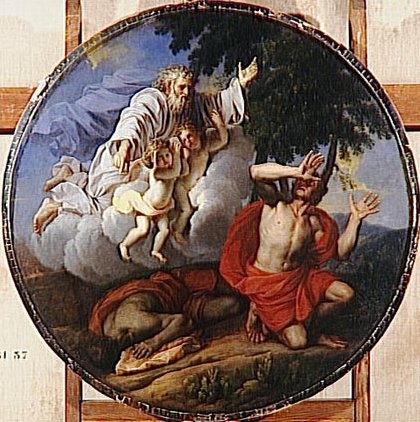
The LORD confronts Cain: What hast thou done?
The voice of thy brother's blood crieth unto me
from the ground.
La Reprobation de Cain apres la Mort D'Abel,
Noël Coypel, 17th century; Louvre, Paris.
In Genesis 4:6-7 it says: And the LORD said unto Cain, Why art thou wroth? and why is thy countenance fallen? 7 If thou doest well, shalt thou not be accepted? The word for accepted
actually translates as 'raised up, exalted', probably referring to
Cain's fallen visage. The Jewish Targums interpret the phrase as 'your
sin be forgiven?' If thou doest well, shalt
thou not be accepted? and if thou doest not well, sin lieth at the
door. And unto thee shall be his desire, and thou shalt rule over him.
Rashi, a medieval French rabbi and author of a comprehensive commentary
on the Talmud and commentary on the Scriptures, says this indicates
that judgment is reserved for the grave. Some think that the LORD is suggesting to Cain to make a propitiatory sacrifice for his error.
Sin lying at the door is a bit of a more contemporary accommodation; the door of the grave
perhaps, as Rashi suggests. The Hebrew word means 'opening' from a root
'to break forth', which is just what happened to Cain: he reputedly
became immersed in sin.
Genesis 4:13 continues the tragedy when Cain laments: My punishment is greater than I can bear. 14
Behold, thou hast driven me out this day from the face of the earth;
and from thy face shall I be hid; and I shall be a fugitive and a
vagabond in the earth; and it shall come to pass, that every one that
findeth me shall slay me. 15 And the LORD said unto him, Therefore whosoever slayeth Cain, vengeance shall be taken on him sevenfold. And the LORD set a mark upon Cain, lest any finding him should kill him.
The Targum Pseudo-Jonathan, quoted above, quotes the passage, 'And the
Lord said to him, Behold now, any one who killeth Kain, unto seven
generations vengeance shall be taken of him.' The Targum Onkelos, also
translated by J. W. Etheridge in 1862, concurs, 'who killeth Kain, unto
seven generations it shall be exacted of him.' The Greek Septuagint
renders the passage: 'everyone who kills Cain will loose seven
penalties'.
Bible commentator John Gill [1697–1771] points to an interesting
variant by rabbinical writers: 'not as Jarchi [Rashi] and Aben Ezra
interpret it, that God deferred his vengeance on Cain unto seven
generations, and at the end of them took vengeance on him by Lamech,
one of his own posterity, by whom he is supposed by that Jewish writer
to be slain.'
Cain begat Enoch; unto Enoch was born Irad; Irad begat Mehujael,
and Mehujael begat Methusael, and Methusael begat Lamech: six
generations. In Genesis 4:23 Lamech cries: I have slain a man to my wounding, and a young man to my hurt. 24 If Cain shall be avenged sevenfold, truly Lamech seventy and sevenfold. The Greek Septuagint renders Lamech's lament: 'because vengeance has been extracted seven times from Cain'.
This rendering by the Septuagint turns the whole idea of the fate of
Cain on its head. From this interpretation over the centuries a story
emerged that Lamech had become blind; his son was Tubal-cain - the seventh generation. Tubal-cain would go hunting with Lamech, an excellent hunter, in order to help him aim his bow towards wild game.
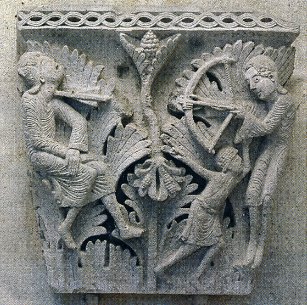
12th-century column capital, Cathedral of
Saint-Lazare, France, shows blind Lamech
hunting with his son Tubal-cain, who is
pointing out a noisy target in the bushes.
They accidentally kill Cain, mistaking him
for a wild animal.
Cathedral Museum of St. Lazare, Burgundy, France
The Bridgeman Art Library

Lamech kills Cain with his bow and arrow
as his son Tubal-cain points to an unobserved
noise in the wild. After taking his shot, Lamech
and his son discover that they have pierced their
ancestor, Cain. By some accounts, in horror,
Lamech claps his hands together, hitting his son
and killing him also.
From Egerton Genesis Picture Book; originally
published in England ca. 1360
BRITISH LIBRARY / SCIENCE PHOTO LIBRARY
Tubal-cain hears a rustling in the bushes and directs his father's bow,
perhaps seeing the horn on the head of Cain and thinking it is some wild game for prey. The resulting killing of Cain
is an accident, thus relieving Lamech of any guilt in planning Cain's
death or countermanding G*d's word. Since Lamech's son is the seventh
generation from Cain, the premise of such as Rashi and perhaps the
Septuagint is realized. [For a discussion of the Lamech legend and ways
the story has been changed, see Cain and Abel in Text and Tradition: Jewish and Christian Interpretations of the First Sibling Rivalry, John Byron; Themes in Biblical Narrative 14 (Leiden: Brill, 2011).]
In support of this legend, commentators point out that the Hebrew word 'ish 'man' is used only twice in Genesis chapter 4: when Eve says, 'I have gotten a man from the LORD' [i.e.: Cain] and when Lamech says, 'I have slain a man to my wounding.' The normal word in Genesis for 'man' is 'adam, thus lending credence to the idea that Lamech had killed Cain.
In his book, Legends of the Jews
[1909], Louis Ginzberg says that Lamech's wives wanted to part from
him, fearing the wrath of G*d against their husband for Cain's death.
They decided to refer the matter to Adam, who considered and decided
the case in favor of Lamech. Some rabbinical writers believe that
Lamech, a libertine in his own standing, was the first polygamist; it
is said that one wife was used for rearing children while another was
kept for carnal pleasure.
Traditionally it has been believed that Cain and his posterity passed away in the Great Flood. The Book of Jubilees
[perhaps second century BCE; it also appears in various Dead Sea
Scrolls] 4:31 says, 'At the close of this jubilee Cain was killed after
him [Adam] in the same year; for his house fell upon him and he died in
the midst of his house, and he was killed by its stones; for with a
stone he had killed Abel' [translation by R. H. Charles, 1917].
The International Standard Bible Encyclopedia
has pointed out that the pre-flood names in the line of Cain and the
names in the pre-flood line of Seth have a striking similarity - the
first with seven patriarchs, the latter with ten. The ISBE points out
that the names resemble the ten kings of Babylonia who reigned before
the flood, according to the third century BCE Babylonian historian,
Berosus. Commentators have sometimes mistaken the names in one line for
the other - such as Lamech: one the father of Noah, the other the
father of Tubal-cain. Ginzberg, mentioned above, says that Lamech had a
daughter named Naamah; some also say that was the name of Noah's wife.
Again, confusion between the two has arisen.
= = = = = = = = =
= = = = = = = = = =
A WORD ABOUT THE BACKGROUND IMAGE 
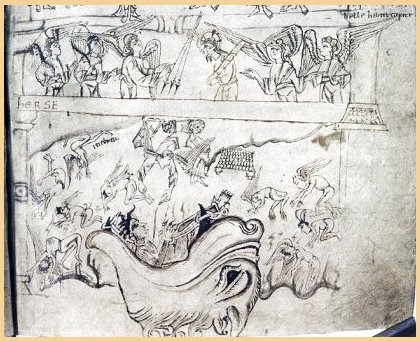
This drawing on parchment is part
of the Caedmon Manuscript in the
Bodleian Library at Oxford
University. It is described as a
wrathful Deity attended by angels
striking downward with javelins.
Below Lucifer falls with his
shattered throne into the mouth
of Hell - seemingly with his many
works. ca. 1000 CE.
Roll title: MS. Junius 11
Folio or page no.: p. 003

