of
BAPTISM
The Gospel of Luke, chapter 3 verse 2, states: ... the word of God came unto John the son of Zacharias in the wilderness. 3 And he came into all the country about Jordan, preaching the baptism of repentance for the remission of sins ... verse 16: ... I indeed baptize you with water; but one mightier than I cometh, the latchet of whose shoes I am not worthy to unloose: he shall baptize you with the Holy Ghost and with fire.
The Mystery of baptism is not so much why John was doing it, but from whence did he get the idea; what was he saying about baptizing with fire? It is generally accepted that the idea of immersion arose from the purification bath practiced by the Jews, particularly by those of the Qumran community: the Essenes. That cleansing bath was called the miqveh or miqvah, a Hebrew word meaning 'collection', especially of water, a pool. The Dead Sea Scrolls, ostensibly written by the Essenes, mention the miqvah in detail, and describe how it must comprise moving water with an entrance at one place and an exit at another. Qumran had a number of purifying pools, as did Jerusalem near the Temple Mount. Purification was mandatory in the Temple precincts and prior to the worship service.
The word miqvah appears first in the Hebrew Scriptures in Genesis chapter 1 verse 10: ... the gathering together [miqvah] of the waters called He Seas... It is also used in Exodus chapter 7 verse 19 when Aaron is directed to stretch his rod over all their pools of water. The 16th chapter of Leviticus, verses 4 and 24 mention that the priest should cleanse his flesh in water before coming into the presence of the LORD; chapter 15 talks of how any Jew should cleanse his flesh whenever there is any semblance of having touched anything unclean.
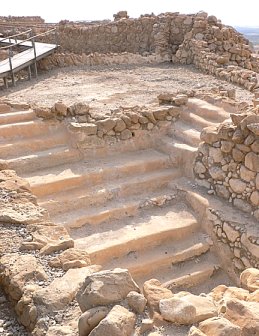 Miqvah at Qumran; notice two sets of steps, one each for entering and exiting the pool. [graphic borrowed from http://www.stellarproducts.com/about/personal/vacations/Israel2009/southern.htm]
 The Holman Bible Dictionary suggests that the Qumran community may have required an immersion baptism in order to initiate new members into the fellowship. Holman says that the [Greek word] baptizo 'baptize' does not, however, appear in the Dead Sea Scrolls; why a Greek word should appear in their mostly Hebrew writings is not made clear by the commentators.
 The first chapter of the Gospel of John states that John was baptizing at Bethabara beyond Jordan.
The map to the right shows the location of Qumran in relation to where
John practiced immersion in the River Jordan to cleanse of sin. It is
not far-fetched to consider a bond between John and the Essenes.
The first chapter of the Gospel of John states that John was baptizing at Bethabara beyond Jordan.
The map to the right shows the location of Qumran in relation to where
John practiced immersion in the River Jordan to cleanse of sin. It is
not far-fetched to consider a bond between John and the Essenes.The Essene sect was started by a somewhat mysterious figure called 'The Teacher of Righteousness' who withdrew in dissent from the Temple and Jerusalem over a century prior to John's time. Before he was killed he prophesied that another Teacher would arise at the proper time [or perhaps he referred to his own resurrection] to justify the reality of the sect.
Could John the Baptist have been that second Teacher? John stated that he was a voice crying in the wilderness come to make straight the way of the LORD [Isaiah chapter 40 verse 3.] The Dead Sea Scroll labeled 1QS - The Community Rule - also quotes Isaiah 40:3: And when these become members of the Community in Israel according to all these rules, they shall separate from the habitation of unjust men and shall go into the wilderness to prepare there the way of Him. [Translation by Geza Vermes.] While the implication of such a relation of John with the Essenes is huge, the evidence is scant.
Referring to Luke 3:16, quoted at the top of this page, we see baptism by water - in Hebrew miqvah
 [read from right to left; the small marks below the letters are called
'pointings' and indicate the vowel sound to follow; there are no true
vowels in Hebrew.] There is another word in Hebrew, mikvah
[read from right to left; the small marks below the letters are called
'pointings' and indicate the vowel sound to follow; there are no true
vowels in Hebrew.] There is another word in Hebrew, mikvah  , which means 'a burning'. Obviously the difference between the two words is the qôph [q] in the middle of the first and the kaph
[k] in the middle of the second; for all intents and purposes the words
sound the same. Perhaps when John spoke of the baptism by water and the
baptism by fire ['a burning'] his listeners thought of the homonym - as
a bit of a pun.
, which means 'a burning'. Obviously the difference between the two words is the qôph [q] in the middle of the first and the kaph
[k] in the middle of the second; for all intents and purposes the words
sound the same. Perhaps when John spoke of the baptism by water and the
baptism by fire ['a burning'] his listeners thought of the homonym - as
a bit of a pun.One could hypothesize that John using the words as a pun might be to prove to his audience that he was connected with the Essenes - who were not far away above his location in the Judean wilderness; we already saw how the Essenes emphasized ritual bathing - often.
Interestingly, the word miqveh can also mean 'hope'; it is so used in Ezra chapter 10 verse 2. It also appears in I Chronicles chapter 29 verse 15 translated in the King James Version as 'none abiding', which Matthew Henry interprets as 'no expectation' - or 'no hope'; the NIV translation renders the phrase as 'without hope'. It is also possible that those visiting John associated 'hope' with baptism and perhaps even Messiah.
= = = = = = = = = = = = = =
In the Gospel of Luke chapter 1 verse 36 the Holy Spirit tells the virgin that her cousin
Elizabeth has also conceived; that passage refers to the birth of John
the Baptist. Obviously that would mean that John and Jesus were
related. Therefore, if John was an Essene, would that not mean that
Jesus was also an Essene? ...that the Essenes were in fact Christians?This reasoning comprises perhaps the main criticism among scholars of those connecting the Essenes with Christianity. The sectarian scrolls amongst the Dead Sea Scrolls, such as The Community Rule mentioned above, define the most strict legal practices; we have already mentioned the practice of frequent ritual bathing for purification.
This may evince a pre-conceived bias on the part of these critics. This author would like to propose a perhaps radical theory concerning the Essenes.
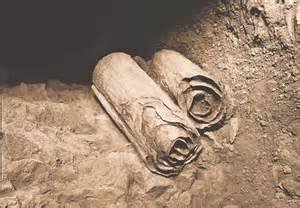 What
are the Essenes best known for today? One would have to say that it was
their dedication to copying and inscribing the Hebrew Scriptures. Why
did they spend almost all their time writing their scrolls and
preserving them? According to the Talmud, there was a standard copy of
the Scriptures kept at the Temple in Jerusalem for copying, and
correctors among the officers of the Temple. So why were the Essenes
constantly busy copying and preserving the holy text?
What
are the Essenes best known for today? One would have to say that it was
their dedication to copying and inscribing the Hebrew Scriptures. Why
did they spend almost all their time writing their scrolls and
preserving them? According to the Talmud, there was a standard copy of
the Scriptures kept at the Temple in Jerusalem for copying, and
correctors among the officers of the Temple. So why were the Essenes
constantly busy copying and preserving the holy text?Perhaps there were differences in the accepted texts of each group. We cannot verify the text of the Temple copy, but the Dead Sea Scrolls contain many of the books of the Hebrew Cannon; when compared to the text of the Masorah - the accepted text today of the Hebrew Testament - the correlation is quite striking. According to the Hebrew scholar, Lawrence Schiffman, 80% of the scrolls favor the Masoretic text, while only 5% favor the Samaritan, 5% the Greek Septuagint and 10% variously. [L. Shiffman, Reclaiming the Dead Sea Scrolls, Yale University Press; (2007)]
Still, why go to all the effort to preserve separate copies of the Scriptures? John quoted Isaiah [above] and was obviously educated; his father, Zacharias, performed the priestly function in the Temple, presumably as a visitor [Gospel of Luke chapter 1.] The holy texts were intended by the Essenes for some specific use. Perhaps the original Teacher of Righteousness had a Word of Knowledge about the coming Messiah and separated from the Jerusalem Temple crowd in order to prepare for His coming. A true copy of the accepted texts would be important.
What was Jesus occupied with from childhood to adulthood? Certainly, according to Luke chapter 2, at age twelve He could discuss the Scriptures with the learned doctors of the Temple. As the son of a carpenter one would not expect Him to be deeply familiar with the holy texts and their meanings. Was Jesus tutored by the Essenes?
The argument that the Essenes were too loyal to the Law [Torah] to have any relationship with later Christianity is misleading. Presuming that the Teacher of Righteousness had a revelation about the coming Messiah, how else could he prepare for His advent other than by the Scriptures as he understood them? He organized a community in which to nurture and educate the coming Savior, and demanded a high standard of holiness fom his followers in order to ensure a proper environment for such a holy arrival. That motivation carried the Essene group for many decades after the death of the Teacher.
While the Essenes might have had their own ideas anticipating what the Messiah would teach and stand for, they could not dictate to Him what He should do. It is likely, from reading the War Scroll, that the Essenes hoped for a king that would throw off the Kittim - interpreted to be Romans by most scholars.
One argument for a relationship between the Essenes and later Christianity is that the New Testament texts mention the major Jewish groups of the time - the Pharisees, the Saducees and the Scribes - but make no mention of the Essenes. According to the contemporary historian, Josephus, the Essenes were a major sub-grouping in Israel. The argument contends that the Essenes were not mentioned in the New Testament because they were connected with the Christians.
It is odd that in the Gospel of Luke chapter 7 John sends his disciples to Jesus to ask, Art thou he that should come? or look we for another? Jesus was his cousin and they had grown up together. Was the question due to doubt in the Essene community due to the differences in what they had been led to expect and the more lenient, tolerant teachings of Jesus? Were they perhaps looking for a Davidic king to throw off the yoke of Herod and the Romans?
= = = = = = = = = = = = = =
Ritual purification bathing
was practiced in Jerusalem, at Qumran and at the Jordan by John at the
time of Jesus' ministry. Perhaps it is not possible to conclusively tie
John and Jesus to the Essenes and/or the Qumran community. Still, it is
a question that inevitably arises.
